
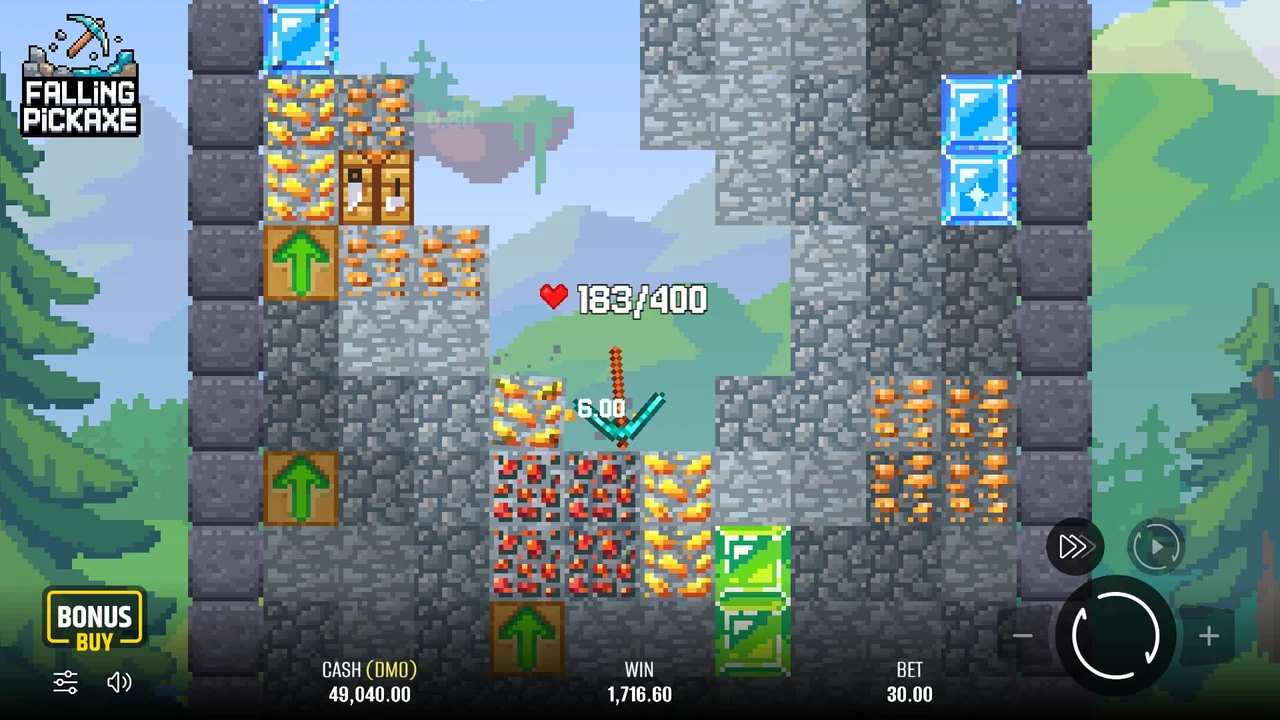
Falling Pickaxe is a mining-themed instant win game with slot-style pacing, but its action revolves around symbols that behave very differently from classic reels. Instead of matching icons across paylines, you trigger a mining run by landing a pickaxe, then watch it crash through layers of blocks that can drain durability, boost multipliers or unlock stronger payouts. That unusual format is exactly why a clear guide to Falling Pickaxe symbols is worth reading before playing for real money.
This page breaks down the full symbol set in Falling Pickaxe for Australian players, including block types, pickaxe durability, special feature symbols and likely value ranges. If you want to understand what happens when a Wooden, Stone, Iron or Diamond pickaxe drops into the grid — and why TNT or multiplier blocks can change a round instantly — you’ll find the key details below.
Main symbol groups in Falling Pickaxe include:
- Pickaxe symbols — Wooden, Stone, Iron and Diamond
- Standard blocks — dirt, stone and basic ore layers
- High-value blocks — gold, diamond, emerald-style premium ore
- Feature blocks — TNT, upgrade symbols, multiplier blocks and bonus-style special blocks
Falling Pickaxe at a Glance for Australia
Falling Pickaxe is a Pixmove instant win title built around a mining mechanic rather than traditional reel combinations. At Falling Pickaxe Casino, it is typically positioned as a fast, low-friction game that works well in both demo and real-money mode, making it attractive to Australian players who prefer quick sessions on desktop or mobile.
For local users, the appeal is simple: low entry stakes in AUD, rapid rounds and the chance to hit stronger multipliers when deeper pickaxes connect with premium blocks. While the game is easy to start, the symbol mechanics matter far more than in a standard instant game, because every block hit affects durability, progression and final payout potential.
Falling Pickaxe Game Details for Australian Players
| Item | Detail |
|---|---|
| Game type | Instant win / mining-style slot |
| Developer | Pixmove |
| RTP | Around 95% |
| Volatility | Low to medium |
| Top potential | Up to around x160 total multiplier |
| Core mechanic | Spin, land a pickaxe, then drop through blocks |
| Play modes | Demo and real money |
| Device support | Desktop, tablet and mobile |
| Typical stake style | Low-stakes casual play through to larger bets in AUD |
Swipe the table sideways to see every column.
Every symbol on the board matters. Pickaxes decide how far a run can go, while blocks determine whether that durability turns into low-value terrain hits, multiplier growth or a premium ore payout.
How Falling Pickaxe Symbols Trigger Wins
A round begins with a stake selection and a spin on a compact reel. That reel can land one of four pickaxe symbols — Wooden, Stone, Iron or Diamond — or a cross symbol that means no mining drop starts on that spin. When a pickaxe lands, it falls into the vertical block field and begins breaking through whatever sits below it.
The key stat here is durability, usually described as HP. Each pickaxe starts with its own HP pool, and every impact reduces both the block’s resistance and the pickaxe’s remaining strength. Once the pickaxe reaches zero HP, the drop ends and the game totals the rewards collected during that run.
Not every block pays directly. Some are simply terrain and act as a cost of progression, forcing the pickaxe to spend HP to move deeper. Others carry fixed values, multiplier boosts or special effects such as TNT explosions and upgrades. That balance is what gives Falling Pickaxe its hybrid feel: part instant win, part cascading progression game.
There is also a useful safety net in the format. If several spins in a row land the no-pickaxe cross, the game uses a guaranteed hit feature so the next eligible spin produces a pickaxe rather than extending the dry spell too long. That helps keep the action moving, especially during short mobile sessions.
In simple terms:
- Pickaxes decide how deep a run can go
- Blocks are the symbols being hit during the descent
- Special blocks can add multipliers, create explosions or improve the pickaxe mid-run
Falling Pickaxe Pickaxe Types Explained
The four pickaxe symbols are the heart of the game. They determine not only how many blocks you can break, but also how often you realistically reach better-value ore and high-impact feature symbols. In practice, stronger pickaxes create longer, more volatile runs with more chances to chain effects together.
Pickaxe Durability and Depth in Falling Pickaxe
| Pickaxe type | Approx. HP | Depth profile | Best suited to |
|---|---|---|---|
| Wooden | ~100 HP | Short, shallow runs | Casual low-risk sessions |
| Stone | ~150 HP | Moderate depth | Balanced play |
| Iron | ~200 HP | Deeper mining routes | Mid-tier multiplier hunting |
| Diamond | ~400 HP | Long, deep runs | Premium ore and bigger multiplier potential |
Swipe the table sideways to see every column.
Wooden Pickaxe in Falling Pickaxe
The Wooden Pickaxe is the lightest tool in the game and usually the least durable. It tends to produce short drops that break through only the upper layers of the board, where standard terrain and lower-value blocks are more common. For that reason, it is often seen as the lower-variance starting point.
That does not mean it is useless. Wooden runs can still connect with small multiplier gains, generic ore and the occasional well-placed feature block. For Australian players keeping stakes modest, it suits quick sessions where the goal is steady entertainment rather than chasing deep premium layers.
Key traits of the Wooden Pickaxe:
- Lower durability, around 100 HP
- Usually reaches shallow block zones
- Better for frequent small interactions than long runs
- Less reliable for hitting diamond-tier ore or multiple stacked features
Stone Pickaxe in Falling Pickaxe
The Stone Pickaxe offers a more balanced profile. With a noticeable bump in HP over Wooden, it can push through extra layers and gives the player a better chance of meeting mid-value ore, small multiplier growth and useful feature symbols before the run ends.
This is often the most practical middle ground for players who want more depth without depending entirely on high-volatility outcomes. It still won’t reach the deepest layers consistently, but it opens more of the game’s symbol set.
Key traits of the Stone Pickaxe:
- Around 150 HP
- More stable access to mid-board content
- Better chance of combining ore hits with multiplier blocks
- Suitable for balanced bankroll sessions
Iron Pickaxe in Falling Pickaxe
The Iron Pickaxe is where the mining mechanic becomes more exciting. With roughly 200 HP, it can go deep enough to expose stronger ore blocks and build much better multiplier chains than Wooden or Stone can produce on average.
Iron drops are often where TNT, upgrades and premium ore begin to matter more consistently. They offer a stronger risk-reward profile for players who are comfortable with a bit more swing in exchange for more interesting symbol combinations.
Key traits of the Iron Pickaxe:
- Around 200 HP
- Reaches deeper layers with greater regularity
- Better potential for gold and premium block sequences
- Stronger fit for multiplier-focused play
Diamond Pickaxe in Falling Pickaxe
The Diamond Pickaxe is the premium symbol and the most durable by a wide margin. With around 400 HP, it has the best shot at travelling deep into the grid, where valuable ore, larger multiplier jumps and chain-reaction features can come together in a single drop.
This is the pickaxe most associated with the game’s top-end outcomes. It does not guarantee a big win, but it gives players the best mathematical access to the richest parts of the block field and the strongest total multipliers.
Key traits of the Diamond Pickaxe:
- Roughly 400 HP
- Best for deep-board access
- Highest chance of reaching diamond and rare bonus-style blocks
- Most suitable for players chasing larger upside
Wooden, Stone, Iron and Diamond Pickaxes Compared
The Falling Pickaxe wooden stone iron diamond pickaxe differences come down to three things:
- Durability — stronger pickaxes survive longer
- Depth — more HP means more layers reached
- Potential — deeper layers contain better-value ore and more powerful feature interactions
Base Terrain Symbols and Their Effect on Your Run
A large share of the grid is made up of standard blocks. These are the everyday terrain symbols that shape the run by consuming HP and slowing the pickaxe before it can access more rewarding layers. They may not look exciting, but they are crucial to how the game balances risk and reward.
In most cases, dirt and basic stone offer little or no direct payout. Their job is to absorb durability and make deeper progress meaningful. Generic ore can sit between the lowest and highest-value layers, sometimes awarding a small return or minor multiplier addition while still acting as resistance.
Because standard blocks appear so often, they heavily influence session rhythm. A run with too many plain terrain hits can end before reaching anything premium, while a smoother path through lighter resistance can leave enough HP for gold, diamond or special feature blocks deeper down.
Common Block Types in Falling Pickaxe
| Block type | Appearance | Role | Effect on gameplay |
|---|---|---|---|
| Dirt | Brown pixel block | Base terrain | Reduces HP, usually no payout |
| Stone | Grey rough block | Common symbol | May provide tiny value or small multiplier growth |
| Generic ore | Slightly coloured stone | Mid-tier block | Small block value and light multiplier support |
Swipe the table sideways to see every column.
One useful thing to remember is that a run does not need a huge single hit to become decent. Breaking several low-value blocks in sequence can gradually build the active multiplier, setting up better value if a stronger ore block appears later.
High-Value Ore Blocks in Falling Pickaxe
If standard blocks are the cost of digging, high-value ore blocks are the real reward. These symbols are what most players are trying to reach, especially in longer Iron and Diamond runs. They can bring larger base payouts, bigger multiplier gains, or both.
Gold blocks typically represent the most accessible premium tier. They tend to appear in mid-depth layers and can add a solid return without being extremely rare. Diamond blocks sit further down and usually carry the strongest value potential, making them some of the most desirable symbols in the game. Emerald-style or rainbow premium blocks may also appear as rarer enhanced symbols depending on the board configuration.
The big takeaway is depth. The deeper the pickaxe travels, the better the chance of meeting these richer ore blocks. That is why Diamond Pickaxe runs attract so much attention: they simply give more opportunities to access the game’s most rewarding layers.
Falling Pickaxe Block Values for Premium Ore
| Block | Typical depth | Base block value (x stake) | Multiplier effect |
|---|---|---|---|
| Gold | Mid layers | Approx. 3x–8x | Often adds around +0.5x |
| Diamond | Deep layers | Approx. 10x–50x | Can add +2x or more |
| Emerald / rare premium ore | Mid to deep | Variable | Special boost or enhanced payout effect |
Swipe the table sideways to see every column.
A single high-value block can change the tone of a round, but the strongest results usually come when these hits arrive late in a deep run after smaller multipliers have already been built. For example, several standard and gold hits can raise the active multiplier enough that a final diamond connection becomes much more valuable than its base figure alone.
A few practical points about high-value ore blocks:
- Iron and Diamond pickaxes are better suited to reaching them consistently
- Gold blocks often act as the bridge between average runs and strong runs
- Diamond blocks are rare, but they are central to the game’s bigger totals
- Chained premium hits become far more valuable when multiplier blocks are involved
Falling Pickaxe TNT and Special Symbols Decoded
Special feature blocks are where Falling Pickaxe becomes far more dynamic than a simple break-and-pay game. These symbols can clear terrain, increase pickaxe effectiveness, boost multipliers or even extend the action with extra value opportunities. For many players, they are the most important part of the symbol map.
Falling Pickaxe TNT and Special Blocks Explained
The most recognisable special symbol is TNT. Rather than acting as a penalty, TNT is usually a highly desirable block because it can destroy surrounding tiles in one burst. In effect, it lets the run skip resistance and open hidden paths without spending the same amount of HP one block at a time.
When TNT detonates, it can clear an area around itself, often in something like a 3x3 zone. If another TNT block is close enough, chain reactions may follow, wiping out multiple sections of the board. That can reveal premium ore or multiplier blocks underneath and dramatically improve the total return of a drop.
Upgrade-style symbols add another layer of excitement. These may appear as arrows, workbench icons or other forge-themed visuals. Their role is to improve the current pickaxe during the run, either by enlarging it, increasing penetration or upgrading it into a stronger type altogether. A Wooden Pickaxe that becomes Stone or Iron mid-drop can suddenly stay alive long enough to reach layers it was never likely to access on its own.
Multiplier blocks do exactly what their name suggests. Marked with an x-style visual, they add a fixed jump to the active multiplier and can stack with one another when several are hit in the same run. They are one of the fastest routes to stronger round totals, especially if they appear before a premium ore connection.
Some versions of the game board may also include rainbow or bonus-style blocks. These can behave as rare utility symbols that grant extra drops, permanent multiplier boosts for the round or other enhancements that raise the average value of a good descent.
Special Feature Blocks in Falling Pickaxe
| Special block | Visual cue | Main effect | Strategic value |
|---|---|---|---|
| TNT | Red warning-style icon | Explodes and clears nearby blocks | Opens paths, reveals deeper symbols, saves HP |
| Upgrade / Workbench | Arrow or forge symbol | Improves pickaxe size or quality | Extends the run and increases reach |
| Multiplier block | Glowing “x” icon | Adds instant multiplier boost | Essential for larger totals |
| Bonus / Rainbow block | Rainbow glow | Grants extra drop or special boost | Enhances round value and longevity |
Swipe the table sideways to see every column.
Why these symbols matter so much:
- TNT is positive, not harmful, because it clears resistance efficiently
- Upgrade blocks can transform an average run into a deep one
- Multiplier blocks are key to climbing toward the game’s upper win range
- Rare bonus blocks can add extra value without needing another paid spin
In practical terms, a run with no special blocks may rely purely on raw ore values. A run with TNT, upgrades and stacked multipliers can generate a much bigger outcome even before the final premium block lands.
How Falling Pickaxe Multipliers Build During a Round
The multiplier system is one of the most important mechanics behind final payouts. Instead of applying a single fixed bonus, Falling Pickaxe builds value progressively as the drop unfolds. That means even modest blocks can matter if they arrive in the right order.
The game generally works with an active multiplier that rises during a run. Breaking ordinary blocks may add small increments, while stronger ore and dedicated multiplier symbols add much larger jumps. The result is that a premium block hit late in the drop can be worth significantly more than the same block hit earlier.
Some effects appear to influence only the current descent, while others can improve the base conditions for the rest of that round. That distinction matters because an active multiplier may reset after a completed drop, whereas certain bonus or upgrade effects can leave you in a stronger position while the run is still unfolding.
The maximum multiplier ceiling is not reached often. A realistic cap in the game flow sits around 50x on the multiplier side, and reaching it usually requires several favourable events lining up together: enough durability to go deep, one or more multiplier block hits, and a strong ore connection close to the end of the descent.
Typical Multiplier Growth in Falling Pickaxe
- Standard stone blocks — small incremental boost
- Gold blocks — moderate increase
- Diamond blocks — large jump
- Multiplier blocks — fixed boost, often the biggest step changes
| Hit sequence | Example multiplier path |
|---|---|
| Several stone blocks | 1.1x → 1.3x → 1.5x |
| Gold plus terrain hits | 1.5x → 2.0x → 2.3x |
| Late diamond block | Can jump into the 5x–10x range |
| Chained multiplier blocks | 10x → 20x+ with cap pressure building |
Swipe the table sideways to see every column.
For players trying to read the board, the lesson is straightforward: not every valuable run starts with a valuable symbol. Sometimes the best outcomes are built slowly, then converted by one deep premium hit at the right moment.
Smart Symbol Tips for Australian Players
Australian players often favour fast mobile-friendly casino games, and Falling Pickaxe fits that preference well. Still, a little symbol awareness can make sessions feel more controlled and enjoyable, especially if you are deciding between low-stakes entertainment and more volatile multiplier chasing.
If you prefer shorter, lower-swing play, Wooden and Stone pickaxes make more sense. They keep the action moving without depending too heavily on rare deep-board outcomes. If you are comfortable with more volatility and want access to better ore and bigger multiplier combinations, Iron and Diamond pickaxes are naturally more appealing.
Special blocks deserve extra attention. Early TNT can be extremely valuable because it opens the grid before too much HP is lost. Upgrade symbols are just as useful, especially on weaker pickaxes, because they can push a run into layers that would otherwise stay out of reach. Multiplier blocks matter most when they combine with later premium ore rather than arriving after the best symbols have already been passed.
Practical symbol-based tips:
- Match your stake size to the likely volatility of the pickaxe type
- Use Wooden or Stone for steadier, shorter sessions
- Look for Iron or Diamond when aiming for deeper block values and higher multipliers
- Treat TNT as a strong opportunity, especially early in the drop
- Learn the colour cues for gold, diamond and multiplier blocks
- Watch how often special symbols appear during your preferred session length
- If playing on mobile, use demo mode first to get used to the pace of symbol interactions
For many Aussie players, the ideal approach is simple: start small, understand how the symbols behave, then raise stakes only once the game flow feels familiar.
Casino Bonuses You Can Use With Falling Pickaxe
It is important to separate game mechanics from casino promotions. Block values, TNT effects and multiplier growth all belong to Falling Pickaxe itself. Bonuses, on the other hand, come from Falling Pickaxe Casino and may increase your playable balance or extend your session if the terms allow this game to contribute.
Australian players will typically find a mix of standard promotional offers built around deposits and ongoing activity. These often include a welcome package for new customers, occasional reload bonuses, cashback offers and VIP rewards for regular play. In some cases, bonus balance or selected free-play credits can be used on instant win or slot-style titles such as Falling Pickaxe.
Common bonus types at an online casino like this may include:
- Welcome bonus on the first deposit
- Reload offers for returning players
- Cashback deals on qualifying losses
- VIP perks such as better cashback or tailored promos
- Bonus balance or free-play credits for eligible games
A few points Australian players should always check:
- Minimum deposit can commonly start from around A$10 to A$25
- Wagering requirements may sit around 20x to 40x on bonus funds
- Instant win games can contribute at a reduced rate compared with classic slots
- Maximum bet rules may apply while a bonus is active
- Not every promotion will include Falling Pickaxe automatically
Before you play, it is worth opening the casino promotions page and checking the latest terms. The best offer is not always the biggest one — it is the one that actually applies to the game you want to play.
Banking Options for Australian Players
Funding a Falling Pickaxe session should be straightforward for Australian users, especially at a casino that supports AUD-friendly payment routes. Most players expect familiar card options, local bank-linked methods and a few digital wallet choices for faster account management.
Visa and Mastercard remain standard choices for deposits, while local options such as POLi, PayID or direct bank transfer are especially useful for players who prefer AUD transactions without unnecessary friction. Depending on the platform, e-wallets like Skrill, Neteller and sometimes PayPal may also be supported. Some casinos additionally offer prepaid vouchers or cryptocurrency methods, though availability varies.
Typical banking expectations include:
- Visa / Mastercard for quick card deposits
- POLi or PayID for Australian bank-linked funding
- Bank transfer for direct account movement
- Skrill / Neteller / PayPal where available
- Prepaid or crypto options on selected platforms
What Australian players should look for:
- Minimum deposits often start from A$10
- Card and e-wallet deposits are usually instant
- Bank transfer withdrawals may take 1–3 business days
- Some methods can involve currency conversion if the casino account is not in AUD
- Fees are often low or zero from the casino side, but your bank or provider may still charge
Winnings from Falling Pickaxe are generally processed like any other casino balance. Once verified, withdrawals follow the standard cashier rules, and any successful mining run simply adds to your withdrawable funds subject to any active bonus conditions.
Falling Pickaxe Symbols on Mobile and Desktop
Falling Pickaxe works well across both desktop and mobile, which is one reason it suits Australian players who like short sessions on the go. The pixel-art style remains clear on smaller screens, and the game’s vertical block layout translates naturally to portrait or compact display formats.
Symbol visibility is particularly important here because the game depends on quickly recognising what the pickaxe is hitting. TNT blocks, multiplier icons and premium ore colours are usually distinct enough to read easily on mobile, while desktop gives more room to watch chain reactions and deeper runs unfold in full.
Touch controls also fit the instant-game format nicely. On a phone or tablet, it is easy to launch a few quick rounds, test the demo mode or switch over to real-money play without dealing with a cluttered interface. The result is a smooth experience whether you are checking block values in detail or simply enjoying the pace of the falling pickaxe mechanic.
Fair Play and Australia-Focused Responsible Gambling Notes
Falling Pickaxe uses random outcomes within the game’s design, RTP and symbol distribution rules. That means no player can predict when a Diamond Pickaxe will land, when TNT will appear or which premium ore blocks will be reached in a given run. Strategy can help with bankroll management, but it does not change randomness.
For Australian players, the essentials are simple: play only if you are 18 or over, and always verify that the casino you use accepts players in your jurisdiction and operates under appropriate licensing. Availability, payment methods and promotional terms can vary depending on where you are located.
A few responsible play reminders:
- Set a budget before you start
- Keep stakes proportional to your bankroll
- Treat multipliers and block values as entertainment, not income
- Use deposit limits, cool-off tools or self-exclusion features if needed
- Stop playing if the game stops feeling fun
Falling Pickaxe Symbols FAQ
The main Falling Pickaxe symbols include the four pickaxe types — Wooden, Stone, Iron and Diamond — plus standard terrain blocks, high-value ore blocks such as gold and diamond, and special symbols like TNT, upgrades and multiplier blocks.
TNT is a feature block that explodes when hit and clears nearby blocks. It can save pickaxe HP, reveal deeper ore, and sometimes trigger chain reactions if other TNT blocks are close enough on the grid.
Multipliers usually build during the drop. Standard blocks may add small increases, while gold, diamond and dedicated multiplier symbols add larger jumps. The final value of a premium hit often depends on how much multiplier growth happened earlier in the run.
The main difference is durability. Wooden pickaxes make shorter runs, Stone offers a balanced middle option, Iron reaches deeper layers more often, and Diamond gives the best chance of long drops, premium ore and stronger multiplier combinations.
Block values vary by type. Dirt and stone are usually low or non-paying terrain, generic ore may provide small returns, gold blocks tend to sit in the mid-value range, and diamond or other rare premium blocks offer the highest payout potential.
In many cases, yes, but it depends on the casino’s terms. Some welcome bonuses, reload offers or bonus balances may apply to Falling Pickaxe, while others may exclude instant win games or count them at a reduced wagering contribution rate.
The game is based on random outcomes controlled by its software rules and RTP, so results are not predictable. For Australian players, fairness also means choosing a reputable, properly licensed casino and playing within sensible limits.
Try Falling Pickaxe Demo First, Then Play for Real
If you want to understand how Falling Pickaxe symbols behave in real time, the smartest place to start is the Falling Pickaxe demo. It lets you see the difference between Wooden and Diamond runs, watch TNT clear the board, and get comfortable with block values before risking real money.
Once you know how the symbols, multipliers and special blocks interact, you can move on to real-money play with more confidence. You may also want to explore the Falling Pickaxe game guide for broader mechanics and check the latest Falling Pickaxe bonuses for Australian players before making your first deposit.